In short:
- Drivers cruising for a free space is a real, measurable driver of urban congestion, wasted fuel, and emissions — not an urban myth.
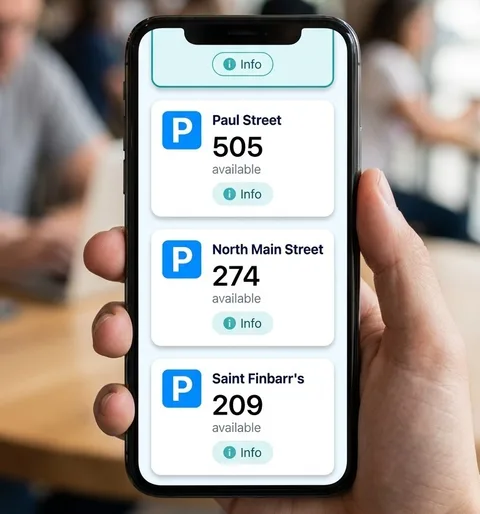
- Cork City Parking Monitor is a free, installable PWA that shows live car park occupancy for Cork city centre before you leave home or while you're en route.
- It's built entirely on Cork City Council's public Open Data API — no scraping, no backend, just a direct call to an official civic data source.
If you've ever driven laps around Cork city centre searching for a parking spot, you already know the problem this app is trying to solve. Cork City Parking Monitor is a lightweight, installable Progressive Web App (PWA) that pulls live car park availability straight from the Cork City Council Open Data Portal and puts it in your pocket — so you know where to park before you've even left the house.
Here's why that matters more than it might seem, and how the app is built.
The hidden cost of "just circling the block"
Searching for parking isn't a minor inconvenience — it's a measurable driver of urban congestion, wasted fuel, and unnecessary emissions.
- A review of sixteen studies conducted between 1927 and 2001 across various cities found that, on average, 30% of cars in congested downtown traffic were actively cruising for parking — not going anywhere, just circling (Shoup, "Cruising for Parking," UCLA). Individual studies in that review found search times ranging from 3.5 to 14 minutes per driver, with anywhere from 8% to 74% of downtown traffic made up of parking-seekers depending on the location and era studied.
- More recent modelling suggests the classic "30%" figure is likely an overestimate for well-managed modern parking systems — some simulations (e.g. San Francisco) found average cruising distances as short as 50 feet where metered parking is actively managed (reinventingparking.org). The honest takeaway: the scale of the problem varies by city and parking management quality, but circling for parking is a real and recurring contributor to downtown traffic, not an urban myth.
- On the demand side, INRIX's large-scale study (combining data from 100,000 parking locations across 8,700 cities with survey responses from nearly 18,000 drivers in the US, UK, and Germany) found that the average American driver spends 17 hours a year searching for parking, at a cost of roughly $345 per driver in wasted time and fuel, adding up to $73 billion annually across the US (INRIX). In dense cities the numbers get worse: New York drivers lose an average of 107 hours a year, Los Angeles drivers 85 hours, and Seattle drivers 58 hours, just looking for a space (ABC7, GeekWire).
Every one of those minutes spent circling is a car idling in traffic that didn't need to be there — burning fuel, emitting CO₂, and adding to the queue for everyone else on the road. Cork is a smaller city than New York or LA, but the same underlying mechanism applies at city-centre scale: uncertainty about where spaces are free pushes more cars onto the road for longer than necessary.
What the app actually does
Cork City Parking Monitor tackles that uncertainty directly by showing you live occupancy data for Cork city centre car parks, sourced from the Cork City Council Open Data Portal. Rather than guessing, you can check availability:
- Before you leave home — see which car parks have space before you even start the engine.
- En route into the city — check again from your phone as you approach, and adjust your route to a car park that's actually got room, instead of finding out it's full only once you arrive.
- At a glance — the app shows live counts and space status for each car park in a simple card layout, so there's no digging through a council website to find the number that matters.
It's built as a Progressive Web App, meaning you can install it to your phone's home screen or desktop like a native app, with a service worker caching assets for fast loading. There is an optional auto-speech feature that reads out availability aloud (helpful if checking hands-free while driving) and a screen wake-lock so the display stays active on the move.
Under the hood: Cork City Council's Open Data API
The app is intentionally simple in its architecture — no backend server, no database, just a client-side app talking directly to a public API. It calls the CKAN datastore_search endpoint on Cork City Council's open data platform:
https://data.corkcity.ie/api/3/action/datastore_search
This is the same open data infrastructure the council uses to publish datasets on car parks, EV charging applications, and other civic data. The app queries the live parking dataset, parses the JSON response for each car park's current occupancy and status (including whether a car park is closed, which it filters out of speech announcements so you're not told to drive to somewhere that isn't open), and renders it into the card-based UI you see on screen. Every refresh pulls fresh figures straight from the council's own data — there's no scraping, no unofficial workaround, just a direct call to a public, documented civic data source, styled and presented in a way that's actually useful for someone about to drive into town.
Why this matters for a city the size of Cork
Cork doesn't have New York-scale gridlock, but city-centre streets are narrow, car parks fill up during peak times, and every extra loop around the one-way system adds to congestion on roads that weren't designed for high traffic volumes. A tool that shifts even a fraction of that "cruising for parking" traffic into a single, informed trip (because the driver already knew where to go) makes a practical contribution to smoother traffic flow and lower emissions.
That's the whole idea behind Cork City Parking Monitor: take data the council already publishes, make it genuinely useful in the moment it matters, and take some of the guesswork and circling out of city driving.
Cork City Parking Monitor is a free, installable PWA. Data provided by the Cork City Council Open Data Portal.
Thinking about an app built on public or open data?
If you have a civic or commercial use case that could benefit from turning open data into an accessible application, get in touch for an initial chat about what that could look like.